
Delivering major construction works in central London brings a unique set of challenges. The Hart hotel was a clear example of the level of engineering coordination, sequencing and problem-solving required to deliver a complex substructure within a highly constrained urban site.
The original 1,000m² site comprised a partially constructed reinforced concrete basement, a derelict building, and historic buried vaults from previous developments, ultimately expanding to a total floor area of 11,332m² following completion. Boundary conditions added further complexity, with a Grade I listed building, a detached neighbouring structure, a TfL Red Route to the frontage and a narrow side street limiting access.
“Every edge of the site had a different constraint,” says Kirty Hirani, Managing Surveyor.
“There was no standard solution – everything had to be designed around what the site would allow.”

Façade Retention and Controlled Demolition
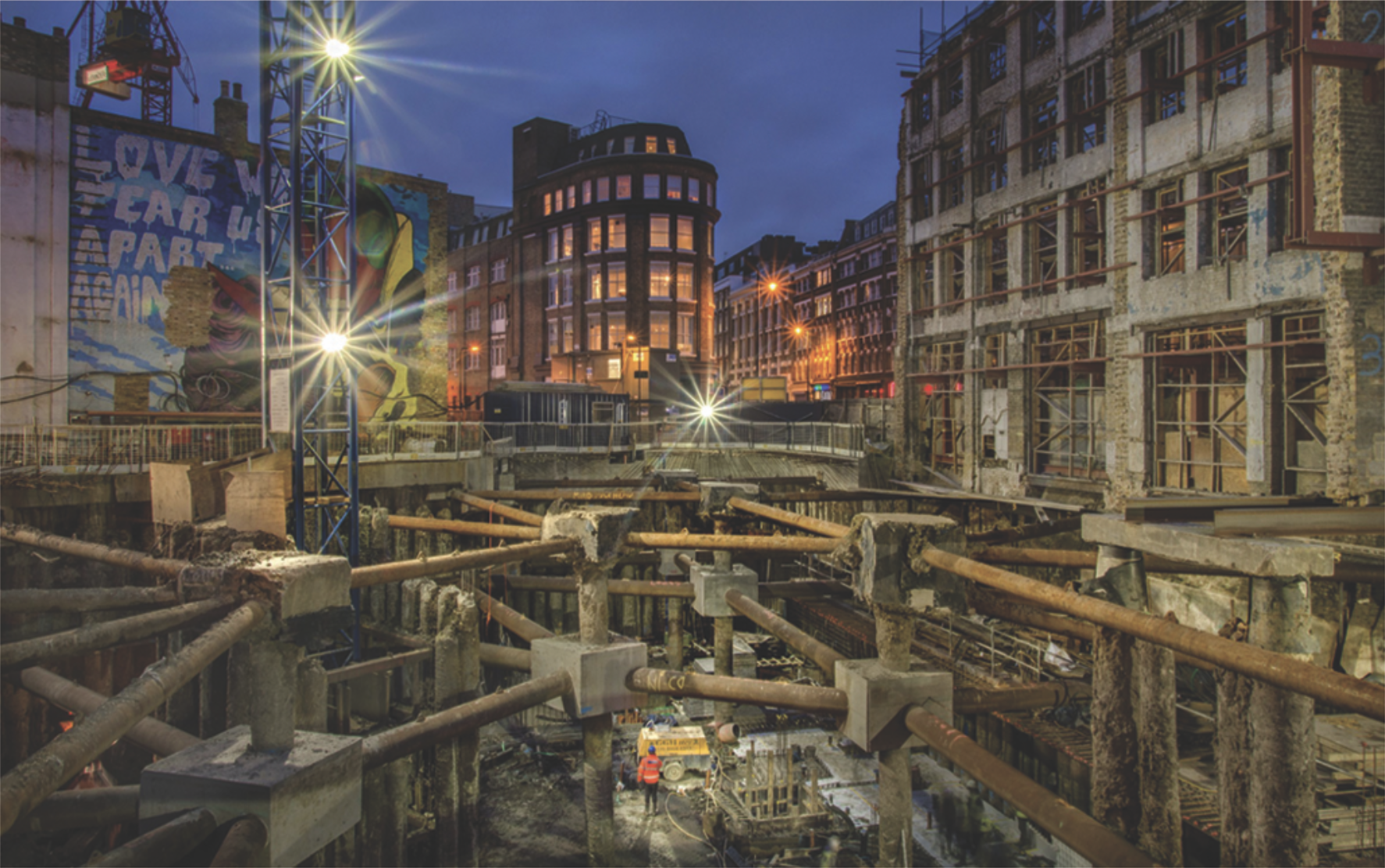
A key early challenge was retaining the existing façade, despite the building being previously unsafe and inaccessible. Vascroft worked closely with temporary works engineers and Transport for London to design a bespoke external façade retention system, installed entirely from outside the site. Works up to first floor level were completed at night to ensure pedestrian safety along the busy route.
A returning wall was also temporarily braced and supported with sacrificial piles, as excavation would extend approximately 11 metres below ground level. The building was subsequently demolished externally, with strict controls in place for asbestos segregation and removal.
“With no internal access, façade retention had to be approached very differently,” Kirty explains.
“Public safety and structural stability were the priority throughout.”


Piling, Excavation and Temporary Works
Following demolition, the existing reinforced concrete basement was carefully removed adjacent to the Grade I listed building using low-vibration methods. Given the site’s wartime history, a UXO intrusive magnetometer survey was undertaken prior to piling and deep excavation.
Once clearance was confirmed, historic vaults were removed and the site was reduced to form the pile mat. Piling works included contiguous, isolated and sacrificial piles to support both the permanent structure and temporary excavation works.
Piles adjacent to the retained façade were installed first and cropped down to maximise basement space. The retained wall was underpinned and tied back to the piles using a sequenced “hit and miss” approach, with excavation progressing to depths of around five metres in confined conditions.

Deep Excavation in a Live Urban Environment
The project required excavation to approximately 11 metres below ground level, involving the simultaneous cropping of 175 piles, management of water pockets behind retained ground, and installation of multiple layers of temporary propping across the site.
To maintain programme continuity, excavation, propping and pile cropping were carefully sequenced to allow multiple operations to progress in parallel.
“Sequencing was critical,” says Kirty.
“Several high-risk activities had to run at the same time without compromising safety or programme.”

Basement Construction and Innovative Drainage Solutions
Once the final formation level was reached, the basement was constructed, beginning with 100mm concrete blinding and installation of the crane base and tower crane.
A significant challenge remained with foul drainage connections. The new connection on Great Eastern Street was located deep and centrally within the carriageway, making road closure and open excavation impractical. Instead, Vascroft tunnelled beneath the road from the lower basement level, employing specialist ex-miners to complete the works safely and efficiently.
“Tunnelling from the basement allowed us to overcome a major constraint without disrupting the surrounding road network,” Kirty notes.

Delivering Under Pressure
The Hart hotel project demonstrates Vascroft’s ability to deliver technically complex substructure works in the most demanding urban environments. Through careful planning, specialist engineering and close collaboration with stakeholders, the team successfully navigated heritage constraints, deep excavation and live infrastructure, delivering a robust foundation for the development above.
Today, that substructure continues to perform as intended, supporting a 125-bedroom hotel rising high above it; a clear testament to the precision, quality and foresight embedded in the early stages of the project.