
Invisible by design, essential by function.
In finished buildings, lifts and escalators are expected to work flawlessly. They’re used thousands of times a day, relied upon without a second though, and rarely noticed unless something goes wrong.
Yet installing them is one of the most complex stages of any multi-storey build.
Building vertically is challenging. Installing the systems that move people safely through that height is even harder. Lift installations demand exact engineering, careful sequencing and millimetre-perfect accuracy. There is no room for error, and no opportunity to disguise mistakes once the structure is complete.
On one of our most complex projects to date, Vascroft delivered our highest number of lift shafts on a single build: 12, at The Westin, London City – a milestone defined as much by precision as by scale.
Case Study 1: Bridewell Place Hotel, London
Bridewell Place is a current Vascroft project in central London and a clear example of the unseen complexity behind vertical movement.
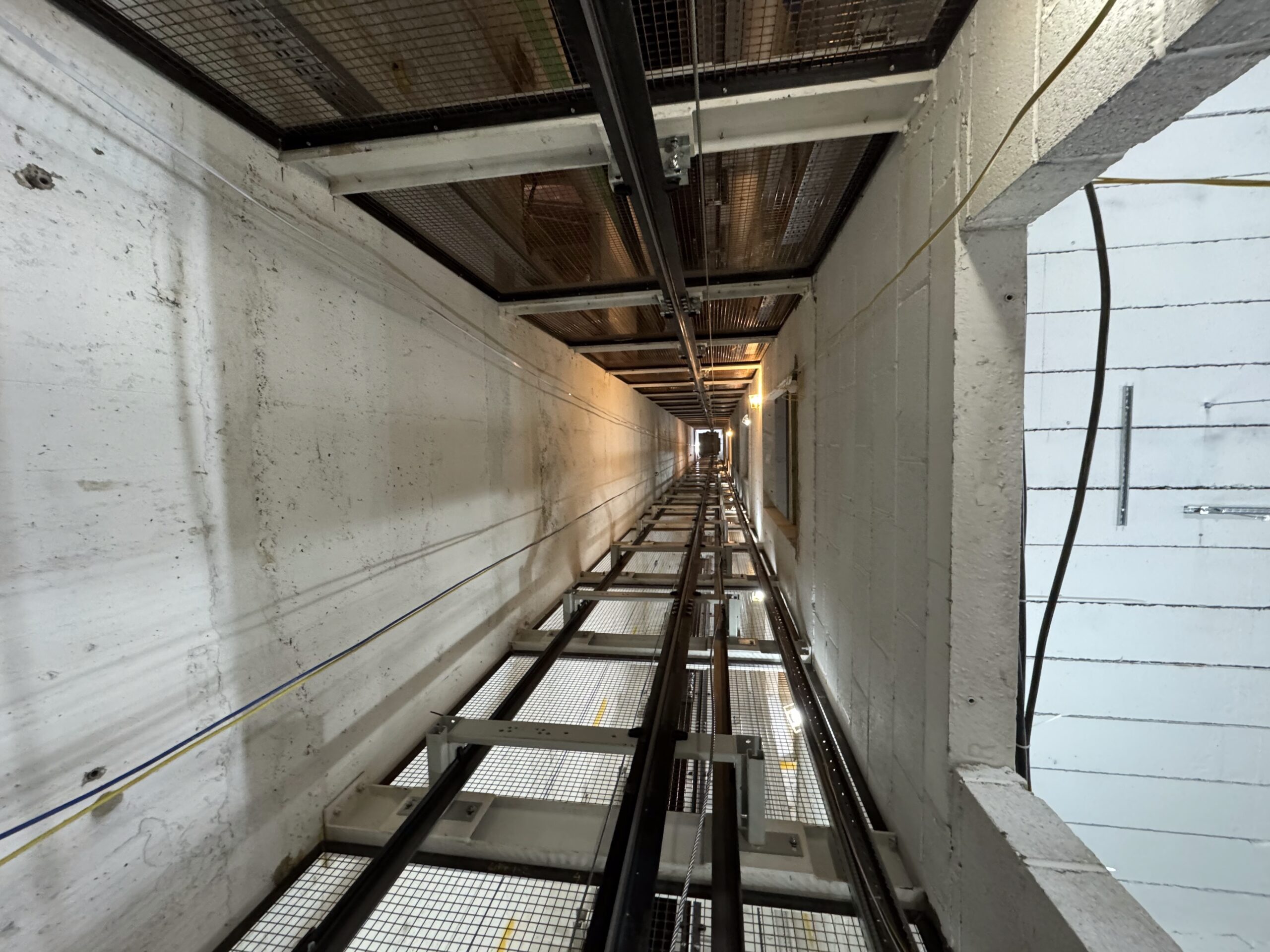
The project involves partial demolition, with four floors above an existing two-storey structure removed and the building then reconstructed up to six new floors. The challenge lay not just in rebuilding upwards, but in working within the constraints of an existing lift shaft.
We spoke with Vascroft Assistant Site Engineer, Manoj Kumar Goduguluru, who explained the challenges first-hand: The original shaft (existing) is 1850mm wide. To service the construction programme, the proposed crane mast required for the works measured 1750mm. On paper, this left just 50mm clearance on either side.
Detailed surveys revealed the reality was tighter still. The existing shaft was not fully plumb, reducing the effective tolerance to approximately 25mm on each side. This demanded close consultation with structural and temporary works engineers to confirm that operating with such minimal clearance would not introduce additional load or pressure on the shaft walls.
Installation required exceptional precision. The crane had to be carefully lowered into the lift shaft from a height of 40 metres, with no margin for deviation. Every movement was planned, checked and executed with absolute control.
This is the kind of work that rarely makes it into final photography – but without it, the building cannot function.

Case Study 2: Westin Hotel, London
At the Westin Hotel, Vascroft delivered its first escalator installation; a different challenge, but one that relies just as heavily on coordination and control.
Escalator installation sits at the intersection of structure, finishes, specialist engineering and logistics. Success depends on effective collaboration between client teams, consultants, specialist subcontractors and the wider supply chain.
This project demonstrated Vascroft’s ability to manage that complexity; aligning programme, procurement and installation to deliver an outcome that was efficient, high-quality and commercially sound.

Built to work, not to be seen
Lifts and escalators are rarely noticed when they’re done well – and that’s exactly the point.
They are the systems that hold a building together in daily use, demanding accuracy, planning and trust across every stage of delivery. At Vascroft, it’s this kind of unseen work (the details that quietly make everything function) that defines the quality of the finished build.